
I've name-dropped the 1982 made-for-TV turkey
Mazes and Monsters a few times, and since the
DVD seems to have quietly gone out of print recently, I thought I'd finally honor it with a proper post.
Based on
Rona Jaffe's sensational novel of the same name,
Mazes and Monsters is a thinly veiled fictionalization of the real-life disappearance of
James Dallas Egbert III, a 16-year old child prodigy and
Dungeons and Dragons player, who went missing for several weeks in 1979, allegedly after attempting to live out his fantasy role playing obsession in the labyrinth of steam tunnels beneath Michigan State University. It was later learned the incident was a failed suicide attempt, and the significance of Egbert's gaming hobby on the emotionally disturbed teen's actions is questionable at best, but that didn't stop an alarmist media from stirring up suburbia with the
Dungeons and Dragons connection.

The premier of
Mazes and Monsters was a bit of an event in my circle of friends, as it gave us a chance to spend two hours of quality time in front of the TV with our parents so they could learn all about our strange new hobby with all the funny dice.

Meet Jay Jay Brockway (
Chris Makepeace), a 16-year old genius attending Grant University, whose 190 IQ and young age make it difficult for him to fit in socially with his college-aged classmates. He deals with this by playing Mazes and Monsters, a fictional "fantasy role-playing game in which the players create imaginary characters...plunged into a fantasy world of invented terrors."
He also wears lots of stupid hats.

Jay Jay is one of four players in an ongoing Mazes and Monsters campaign, the other three being aspiring writer Kate Finch (
Wendy Crewson), Daniel (
David Wallace), a wanna-be game designer being pressured toward a career in computers by his parents, and a fourth player mentioned only in the past tense, who mysteriously "flipped out" last year and isn't returning this semester.
This leaves the group with an open slot that must be filled, and Jay Jay wastes no time posting an ad on the student union bulletin board, where he lurks throughout the day so he can accost any person who happens to read it.

Enter
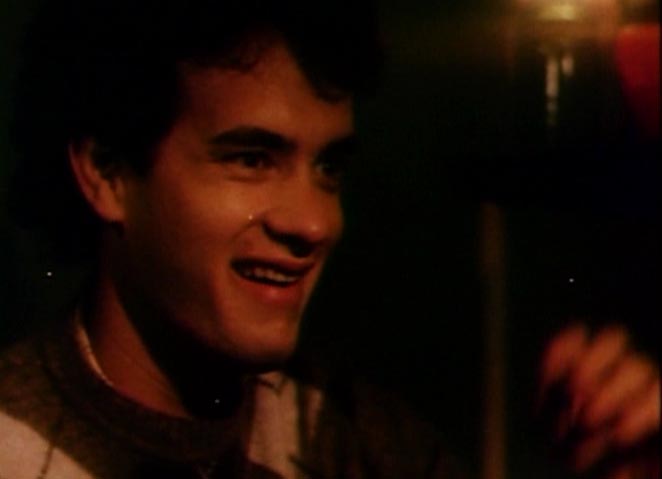
Tom Hanks as Robbie Wheeling, a new student to Grant (poor grades at his previous school forced him to transfer. Something about spending too much time playing a game of some kind...)

If you're wondering what a big star like Tom Hanks is doing within 100 feet of this production, you must remember that in 1982, Hanks was known merely as the slightly funnier guy on the cross-dressing sit-com
Bosom Buddies (his turn as leading man in feature films
Splash and
Bachelor Party wouldn't happen for another two years). Believe it or not, the hottest name on the credits had to be Makepeace, having the summer camp screwball comedy
Meatballs (1979), and high school drama
My Bodyguard (1980) under his belt.
Robbie (Hanks) agrees to join the game after being assured it won't take up too much of his time, a decision no doubt influenced by his attraction to Kate.
 Mazes and Monsters
does make an admirable attempt to accurately portray the mechanics of the typical role playing game. One player, Daniel, is designated "Maze Master", who runs the campaign, keeps the maps, and controls the fate of other players, each of whom have their own hand-written character sheets and miniature figures. That said, how is anyone going to look up armor class tables in a dark room lit only by candles?


 "Your fate is in my hands."
Kate is Glacia the Fighter, Jay Jay is Frelic, "the cleverest of all sprites", and Robbie is Pardue, a holy man, who uses a sword only when his magic fails him.

Robbie is quickly embraced by the group, and an outside-the-game romance soon develops between him and Kate.
But he's still haunted by recurring nightmares of his younger brother Hall. Several years ago, Hall (whose birthday happens to fall on Halloween... lucky boy!) left in the middle of a Halloween/birthday party to run away to New York. Robbie hasn't seen him since, and feels guilty for not keeping a better eye on him.

When Jay Jay learns of Robbie and Kate's relationship, he feels jealous and lonely. In an attempt to reassert his importance in their group, he conceives of an evolved version of the game Mazes and Monsters, to be played out in the nearby "mysterious, forbidden" Pequod Caverns, which have been boarded up and off-limits to visitors since some kids disappeared in them years earlier.
After borrowing a skeleton from the science department and some costumes from theater arts, the group embarks to the Caverns, lanterns in hand, for their new game, with Jay Jay serving as the Maze Master.

After a spooky encounter with some real cave-dwelling bats and Jay Jay's prop skeleton, the group splits up.

Robbie, still affected by his nightmares and having trouble distinguishing reality from fantasy, hallucinates a terrifying encounter with a "Gorvil".

 "The most frightening monsters are the ones that exist in our mind."
The game ends and the group leaves the caves behind, but Robbie, traumatized by the experience, continues to speak and act in-character, as Pardue the holy man. His nightmares about his brother Hall become more intense. He breaks up with Kate, stops attending classes, and shows up at Jay Jay's Halloween party in character as Purdue.

After Robbie isn't seen for several days, Kate, Jay Jay and Daniel search his room, but find only an elaborate hand-drawn game map, labeled "The Great Hall" and "The Two Towers", which they recognize as a reference to Robbie's brother Hall and the second book in
Tolkien's
Lord of the Rings trilogy.


The Mayor of Shark City,
Murray Hamilton, shows up as a police detective investigating their missing friend. He knows about Robbie's involvement in Mazes and Monsters and wonders what part the game may have played in his disappearance.

They finally piece together that Robbie must have left for New York to find his brother ("the Great Hall"), the Two Towers on his map referring to the
World Trade Center. This is the first instance I'm aware of in which Tolkien's
The Two Towers is linked to the twin towers of the World Trade Center. The second wouldn't occur for another twenty years, when an
on-line petition was launched urging director
Peter Jackson and
New Line Cinema to rename the second chapter in their Lord of the Rings film trilogy to avoid any perceived reference to the 9-11 attacks. (A
counter-petition in favor of keeping the title "The Two Towers" also emerged.)

The trio follow Robbie to the top of one of the towers, and are only able to talk him out of jumping to his death when Jay Jay asserts his authority as Maze Master.


In an epilogue meant to be chilling (but had me giggling), they visit Robbie at his parents' house three months later. He's traded in his cleric's robes for a trendy
Le Tigre polo shirt and white shorts, but he's otherwise living in-character, referring to his parents as "the innkeeper and his wife." He invites his old friends to embark on a new quest in the "great forest beyond the enchanted lake" (or perhaps that's just his way of asking for help looking for stray golf balls.)


 And no, this isn't Disneyland's Haunted Mansion... although Mickey visited that in an Oct. 1969 issue of Walt Disney Comics Digest (covered at Doombuggies.com).
 This dilapidated old house is perched on top of a hill in a forest of gnarled, leafless trees, spider-webs, and a skyfull of swooping bats.


 The trio encounters a portrait with shifty eyes...
 ...a bat-infested library...
 ...and a jiggling skeleton...
 Buy it here.




 Posts


