
It was a dark time for Star Wars fandom. The original trilogy had completed two years earlier, with no realistic prospect of new films on the twin-starred horizon. Fans desperate for new Star Wars content had to settle for made-for-TV kiddie fare like the Ewok movies (1984's The Ewok Adventure, and its next-year follow up, Ewoks: The Battle for Endor), and cutesy Saturday morning cartoon The Ewoks and Droids Adventure Hour. Print media spin-off material like the daily newspaper comic strip had ceased publication in March '84, although the Marvel comic book series trudged along for another year before finally wrapping it up in May 1986 after a 107-issue run.
There hadn't been a new Star Wars novel since 1983's Lando Calrissian adventures, and the Timothy Zahn books that would kick-start a new wave of Skywalker fiction wouldn't launch until the 1990's. Immersive Star Wars videogames as we know them today were not yet a thing, and the first role-playing game to tap the Star Wars universe was still two years away (West End Games' Star Wars: The Roleplaying Game book, published in Oct. 87.)
Star Wars, it seemed, was winding down.

Geeks had to work a little harder in those dark times before The Internet to stay in the loop with their favorite fantasy franchises. That sometimes meant ponying up real money for dues membership to fan organizations like The Official Star Wars Fan Club, which remained active through the 1980s. The club's printed newsletter, Bantha Tracks, was still published quarterly, although the focus had turned to other Lucas-related ventures like the Indiana Jones series, Labyrinth, and Howard the Duck, while Star Wars-related content was relegated to the occasional backwards-looking retrospective piece (the club would eventually transform into the more appropriately named Lucasfilm Fan Club in 1987.)
So the good news couldn't have come sooner when it was announced in the Winter 1985 issue (Bantha Tracks No. 27) that Lucasfilm would be collaborating with Disney Imagineers to develop a Star Wars theme park attraction!

Turns out Star Wars was alive, and in perfect hibernation!
The prospect of my two favorite childhood things--Disneyland and Star Wars--finally coming together, was too good to be true. My imagination was ignited with fantastic visions of Disneyland someday devoting an entire land to Star Wars, or maybe even partnering with Lucasfilm to release a slate of new Star Wars films.

But those were just pipedreams.
Naturally, I devoured whatever information I could find about this mysterious new Star Wars ride while it was in development. It was to be called Star Tours, and would use cutting edge flight simulator technology, in which a tilting theater and other interactive elements moved in synchronization with newly photographed special effects footage created by ILM, to send riders on a trip around the post-Return of the Jedi galaxy, made safe for tourism thanks to the defeat of the Empire.
The Bantha Tracks blurb teased a June 1986 opening date, which was later moved to January 1987. This seemed like a huge span of time to wait (much longer than the mere 6-8 weeks it took to receive my considerably less anticipated mail-in Kool-Aid Man videogame ...and in order to cope with that excruciating wait, I had thrown myself into a strange "Kool-Aid Man phase".)
How was I expected to bide my time until Star Tours opened?
Enter Time Voyager.

Opening Memorial Day, 1986, six months before Star Tours, Time Voyager was an "experience of astonishment and wonder" that took passengers on an "intergalactic time travel experience" that blended "special effects, advanced computer technology, three-dimensional imagery, and Dolby sound and motion in an interactive global theatre setting".
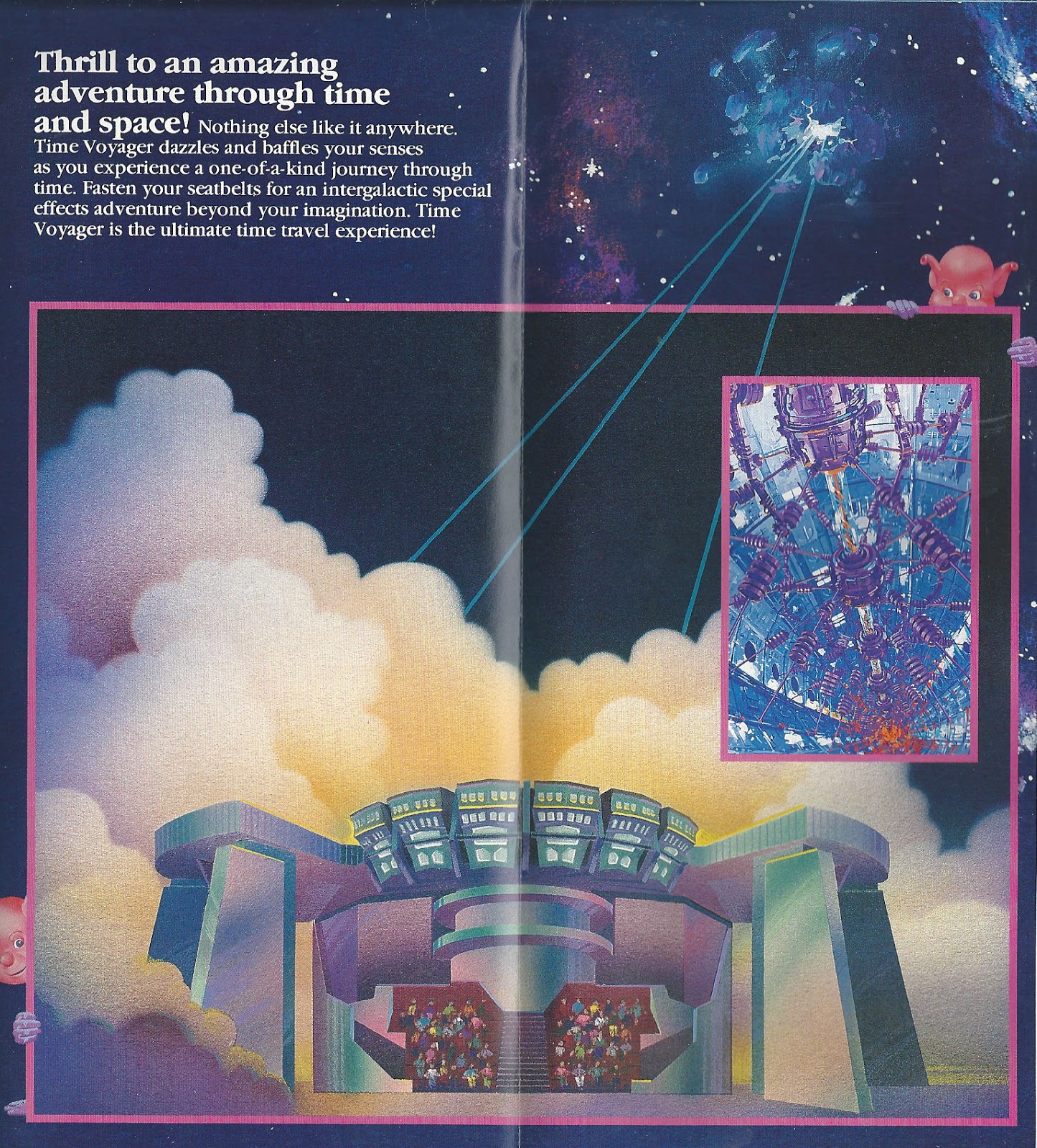
Time Voyager was commissioned by Wrather Port Properties, Ltd. as part of a campaign to reinvigorate the Queen Mary and Spruce Goose exhibits they managed in Long Beach, California. The attraction itself was designed by John F. Decuir, Jr., a special effects designer for film who had worked on Ghostbusters and Fright Night (his father, John Decuir, had done design work for Disneyland, Disney World, and EPCOT Center.)

Installed under the geodesic dome that housed Howard Hughes' H4-Hercules plane, Time Voyager consisted of a sixty-foot diameter, 100-seat carousel-style theater that rotated to face a circle-shaped movie screen (or "porthole"). Electronic tilting seats and in-theater laser effects promised an experience of flight through Earth's atmosphere and into space itself.

Additionally, riders could expect a "close encounter" with friendly aliens called Orbons, who lived in the colony of Orloxin, "known to Earthlings as Halley's Comet".
That a reference to Halley's Comet was worked into the ride narrative was a timely one in 1986, as the short-period comet was completing another 75-year circuit and was visible not only through astronomer's telescopes but in various pockets of pop-culture as well (the 1985 Claymation film The Adventure of Mark Twain depicted a fantastic attempt to visit Halley's Comet on a spaceship, while software publisher Mindscape had released an educational game, The Halley Project, for home computers.)

So we have intergalactic travel, aliens, a flight-simulator style motion theater, laser effects, "astonishment and wonder"... on paper, this sounds like it has all the elements of the anticipated Star Tours attraction. Time Voyager may very well offer a sneak preview into what to expect when Star Tours finally opened the following year, was my thinking, as I convinced my family to purchase tickets ($11.95 for adults, $7.95 for children) when we visited on our 1986 Summer vacation.

Now, I had a real hard time finding information about Time Voyager on the web, outside of promotional blurbs in archived travel magazines. No personal memories posted by riders or vintage vacation photos. No discussions about the history of the ride on fan sites, or virtual recreation videos. Even designer John Decuir Jr's on-line bios frequently omit it (the only mention I could find was at the bottom of his Attractions resume at his website, here.)

And I think I know why.
Time Voyage, it turns out, was very lame.
More disappointing than that awful Kool-Aid Man game!

First of all, the "porthole" screen was just too small. It didn't come anywhere close to filling your field of vision, so the intended immersive effect of a simulator was never achieved. It felt more like you were watching a large television screen than looking out a spaceship window.
Second, rather than the entire theater tilting to simulate the pitch and roll of flight, the theater remained stationary and only your seats moved, tilting jerkily left or right. This simply didn't work. The screen remained stationary as well, so you felt completely disconnected from the on-screen action while watching it from your uncomfortably tilted seat.
Finally, we have to talk about these Orbons. These were the friendly extra-terrestrials that we encounter as we pass Halley's Comet.
Too friendly.

The aliens looked like little bald gremlins, and appeared in person as a full-head costumed character. At some point in the ride, an Orbon would emerge from hiding and proceed to dance around and wave at the audience from the front of the theater.
The handicapped seating was also located towards the very front, putting any wheelchair-seated rider in uncomfortably close proximity to the Orbon's performance area. On my visit, the Orbon, perhaps conscious that a wheelchair rider was practically sharing the stage with him, kept hugging him, patting him on the head, and otherwise making the poor guy part of the show, whether he wanted to be or not. It was all a little cringey, even to this obnoxious teenager.
I have no idea how long Time Voyager lasted, but I did not find it mentioned in a Dec. 1988 blurb for the Queen Mary/Spruce Goose attraction, and it wouldn't surprise me if had closed sooner than that.
Later that day, while roaming around the Spruce Goose exhibit, I passed a mom and dad with a young boy of maybe six or seven, who was cheerfully singing to himself.
The words his sing-song voice was reciting were, "I hate Time Voyager." Ouch!
Anyone have memories of this short-lived, definitely-not-to-be-confused-with-Star-Tours attraction?


 Posts
Posts


