Showing posts sorted by date for query star wars. Sort by relevance Show all posts

Thursday, July 30, 2020

Evangelizing Disney (Mouseketeers at Walt Disney World and Disneyland's 25th Anniversary)

It was somewhat confusing for me to learn that Walt Disney was, in fact, dead.

How was this possible when the studio bearing his name was still releasing new films (The Rescuers, ['77], Pete's Dragon, ['77], Freaky Friday, ['76]) in theaters, the United States was flanked on either coast by a Disney theme park that was open, operating, and adding new rides (Space Mountain, Big Thunder Mountain), and the man himself occasionally showed up on my television set, albeit in a slightly old-fashioned suit, to introduce that night's episode of The Wonderful World of Disney?

It was hard for me to reconcile the fact that Disney--the company--was wielding such a huge influence on my childhood while Disney--the man--had passed on over a decade earlier, before I was even born. How exactly was Disney able to sally forth so successfully without the guiding influence of Walt? 

Unbeknownst to me, industry sentiment at the time was not that the Disney studio was having trouble staying on the path set forth by Walt, but rather was too timid to break away from it.  

"Young people's tastes were changing, and the Disney product was not changing along with it." writes Leonard Maltin of Disney's post-Walt decade (The Disney Films, 3rd Edition, 1995, p. 270)

While the Disney brand still dominated the pop culture I consumed in the 1970s, my tastes were also being informed by the irreverent humor of The Muppets (not a Disney property at that time), PG-rated (and sometimes vulgar) comedies like The Bad News Bears ('76), Meatballs ('79) and Grease ('78), and of course the mega-blockbusters of the decade, Jaws ('75), Star Wars ('77, also not yet a Disney property) and Close Encounters of the Third Kind ('77).

The Cat From Outer Space ('78) and Unidentified Flying Oddball ('79), two examples of the type of corny sci-fi Disney was still releasing in the years following Star Wars and Close Encounters of the Third Kind.

Disney, for its part, seemed stuck in a 1960s time-loop. Some current theatrical releases hewed too closely to Walt-era hits to be appreciated entirely on their own merit. Bedknobs and Broomsticks ('71) was Mary Poppins, but witches. The Aristocats ('70) was One Hundred and One Dalmatians, but cats. Island at the Top of the World ('74) was 20,000 Leagues Under the Sea, but in the air. There were also countless tepid live-action comedies featuring a familiar roster of actors that Disney had been relying on for over a decade, among them a pair of Dean Jones starring sequels no one was clamoring for, The Shaggy D.A. ('76) and Herbie Goes to Monte Carlo ('77).

With a few exceptions, (The Rescuers was both a critical success and, for a while, the highest grossing animated film of all time), it was generally "impossible to distinguish a Disney studio film of the 1970s from one made prior to Walt's death..." (Maltin).

Attempting to course correct, Disney, under the leadership of Walt's son-in-law, Ron Miller, began developing projects that could be described as experimental for a studio built on wholesome G-rated family entertainment. The films from this era, which lasts from the late 70s through the mid-1980s, included the studio's first PG-rated film, released under the Buena Vista banner to obscure its connection to Disney, Take Down ('79), as well as several attempts to tap into genres unconventional for Disney: horror (Watcher In the Woods, '80), off-world sci-fi (The Black Hole, '79), contemporary teen drama (an adaptation of S.E. Hinton's Tex, '82), a screwball scavenger hunt (Midnight Madness, '80), super heroes (Condorman, '81), and, in an unprecedented partnership with an outside studio (Paramount), medieval fantasy (Dragonslayer, '81) and a live-action adaptation of cartoon character Popeye ('80). 


But despite testing these new waters, Disney hadn't given up on the G-rated family market, they just needed to figure out how to convince Generation X to believe in that good ol' Disney magic their Boomer parents had grown up with, a challenge perfectly encapsulated in a scene from Close Encounters of the Third Kind: The Special Edition (1979), in which a 30-something Dad (Richard Dreyfuss) is more excited about the prospect of revisiting all the "furry animals and magic" of a revival showing of Disney's 1940 classic Pinocchio than his disinterested 8-year old son, who dismisses the film as "some dumb cartoon rated G for kids."

It seems it was up to the adults to evangelize Disney magic to the current generation of disbelieving children. And we can see that in two theme-park focused Wonderful World of Disney television specials from that period: The Mouseketeers at Walt Disney World (1977) and Disneyland's 25th Anniversary (1980).

Using the medium of television to promote the theme parks was nothing new for Disney. The original 1954 incarnation of the weekly series that would eventually become The Wonderful World of Disney was named for the still under-construction park, Disneyland, and branded its anthological content to one of the park's four themed lands. Beginning in the 1970s, Walt Disney World was the subject of several episodes, including The Magic of Walt Disney World (1974, an updated presentation of a 1972 featurette).

But by 1977, much of that "magic" was lost on today's kids... that is, if we are to believe what we see in The Mouseketeers at Walt Disney World, in which the cast of The New Mickey Mouse Club performs at a park they seem to have no interest in actually stepping foot in.

All screen caps were pulled from this YouTube upload of the program, although in an odd bit of coincidental timing, while preparing this post it suddenly became available officially on the Disney+ streaming service.

The New Mickey Mouse Club (TNMMC), premiering in January, 1977, was an attempt to reboot the hugely successful 1950s phenomenon, updating it for the modern era with a diversified cast, a disco-fied theme song, and a crayon box explosion of colorful sets and costumes. Remembered today mostly as the launching pad for Facts of Life actress Lisa Whelchel, TNMMC was yet another example of Disney playing it safe by repeating itself. But lightning didn't strike twice (Maltin called the show a "conspicuous failure"), and it limped along for two years before fading into obscurity.

The Mousketeers at Walt Disney World follows TNMMC's multi-day stay at the Orlando resort, chaperoned by a "Mr. Brown" (familiar TV actor Ronnie Schell, who had become a Disney film regular of late, appearing in The Strongest Man in the World, Gus, The Shaggy D.A. and The Cat From Outer Space.)

TNMMC cast arrives via Monorail at the Contemporary Resort, but they don't pause for a moment to marvel at the cavernous Grand Canyon Concourse and its magnificent six-story tall Mary Blair tile mural. Instead, they're excited to try out the not-so-magical tennis courts, an amenity commonly found at non-Disney resorts, sports clubs and parks across the country.
"I can't wait to get to the tennis courts." says Julie Piekarski to Kelly Parsons.

After a musical montage showcasing River Country, a themed water park that opened near Fort Wilderness Campground the year prior, TNMMC kids are seen enjoying rounds of skee-ball and pinball at the Fiesta Fun Center arcade.

While the arcade might be worth highlighting as a feature of the resort, there's little Disney "magic" to be found here that couldn't be replicated at any local mall of the day. When Mr. Brown interrupts their play to distribute park tickets, the kids' disinterest is un-mouse-stakeable.


Just look at the disappointment on the faces of "Pop" Attmore and Kelly Parsons. This is the look of a child receiving a $10 savings bond from Grandma for his birthday, not tickets to the greatest theme park in the world.

Comedienne Jo Anne Worley arrives as investigative journalist Colleen Osborn, who may as well be channeling audience skepticism (or at least, Disney's presumption of same) that this nostalgic 1950s-era Mickey Mouse Club concept will still fly in the raucous 1970s. "Level with me Mr. Brown, are the Mouseketeers really friendly towards each other?" Assuring viewers that TNMMC aren't the clean-cut and polite squares of yesteryear, but rather modern kids with modern attitudes and modern interpersonal problems, they stampede onto the scene, arguing and tearing at each other's clothes.

Anarchy in the W.D.W!

Lest there be any lingering doubt that TNMMC has changed with the times, in a later scene, Lisa Whelchel and Allison Fonte take a break from fighting over a rack of dresses to flirt with an attractive older man, or "fox" as the cool kids say.

This ain't your Dad's Disney vacation--although this "fox" looks old enough to be their Dad. Yikes!


Finally, action moves to inside The Magic Kingdom and, after riding the Tomorrowland Speedway and Space Mountain, the kids actually seem to be enjoying themselves for the first time.

But it doesn't take long for the Disney spell to be broken when the group spends a night camping at Fort Wilderness and an innocent mishap results in a tent collapsing. Blame lands on "Nita Dee" DiGiampaolo and the angry insults from her cast mates are piled on mercilessly... 
"That's really a dumb thing to do"
"Can't you do anything right, Nita?"
"What kind of scramble-brained idiot are you?'"
"Stupid!"
"You ruined our camping trip."
...leaving the poor girl in tears.

(Insert some profound comment about idealized Baby Boomer nostalgia being repackaged for a less optimistic generation that can't fully access it.)

So maybe TNMMC kids were more interested in sports, the opposite sex, and arguing with each other than in the unique pleasures afforded by a day at a Disney theme park. But child actor Adam Rich  threatens to one-up their ap-athy-doo-dah in Disneyland's 25th Anniversary (1980).


With his grandfatherly quality and a twinkle in his eye, you might assume that actor Danny Kaye is a Disney film veteran. But despite having appeared in a few non-Disney family friendly productions (Samuel Goldwyn's musical Hans Christian Andersen, ['52], television adaptations of Pinocchio and Peter Pan, both '76) this is actually his first of only two appearances with Disney (the 2nd being 1982's EPCOT Center: The Opening Celebration.) In addition to hosting duties, Kaye plays multiple character roles, including some comic-relief ethnic stereotypes that wouldn't fly today, even with the help of a magic carpet.

Different times, folks.

After an opening song explaining Disneyland's origin story, ("Once Upon a Time in Anaheim") Kaye delivers a thesis statement: "I've had people say to me, 'Disneyland? That's not for me.' You are never too old and you are never too young to enjoy the Magic Kingdom." But proving that to the audience, and Adam Rich, will take some extraordinary heavy-lifting.

Rich was known as the littlest Bradford child on hit television show Eight Is Enough (in its fifth season), and would go on to appear in exactly one Disney film, The Devil and Max Devlin ('81) Here, Rich is playing "himself", but he's also playing audience surrogate for those skeptical, modern young people Disney thinks it needs to win over.   

When Kaye, as Rich's grandfather, asks Rich what he'd like to do first in Disneyland, his one-word answer is: "Leave." He'd rather go to "Adamland", a.k.a. "home, where I live" than spend a lousy day at Disneyland.

Later, when Kaye leaves to find Grandma (also Kaye, in staggered appearances) in Frontierland, Rich grumbles, "What's so great about Frontierland?"

We are then shown exactly what's so great about Frontierland, at least according to a youth-market courting Disney, and it isn't Big Thunder Mountain, the Mark Twain, or any other attraction built by Disney Imagineers... instead it's a live stage performance by hip singing group the Osmond Brothers (intercut with their 1962 debut appearance at the park on the Wonderful World of Color episode Disneyland After Dark.)

Donny Osmond, who, along with his sister Marie, was by this time an even bigger pop sensation than the older Osmonds, joins them on stage to rock it up a bit. 

Afterword, when Grandma asks Rich to guess where they're going to go next, Rich snaps: "Back to the hotel?" Is it too late to deposit this little grouch at the future site of Disney's California Adventure so the adults can have some fun?

"Back to the hotel?" he quipped. Editors note: slapping children is wrong.

Next, we're treated to a great performance by veteran Disney stage performer Wally Boag (joined by Kaye as a black-hatted gunslinger) at the Golden Horseshoe stage, but Rich misses it all because he'd rather sit by himself on a bench, grumbling, "When are we leaving?"

In fact, the first time Rich cracks a smile at the Happiest Place On Earth is when he bumps into superstar Michael Jackson, who sings "When You Wish Upon a Star" and, referencing his recent appearance in the '78 film The Wiz, "Follow the Yellow Brick Road" and "Ease on Down the Road". Unfortunately Michael Jackson is a seasonal attraction, subject to change, with no guarantee he's going to personally serenade you on your visit. Check the park schedule and plan your trip accordingly.
Six years before Captain EO - it's Michael Jackson at Disneyland in 3-D!

Next is a park-wide sing-a-long of "Zip-A-Dee-Doo-Dah", featuring an era-spanning chorus of celebrities that's part 'Who's Who' (Annette Funicello, Buddy Epsen, Kim Richards, Patrick Wayne, Ruth Buzzi) part 'Who's That?' (Bart Braverman, Danielle Brisebois, Quinn Cummings, Sal Viscuso.) Both Jo Anne Worley and Ronnie Schnell from the The Mouseketeers At Walt Disney World make an appearance here as well, this time as themselves.

Again, we find Rich alone and sitting on a park bench in front of Sleeping Beauty Castle (Another bench? Septuagenarian Danny Kaye has more energy than this kid!) where he falls asleep, launching a dream sequence in which Kaye appears as the "Wild Witch of Disneyland".
No, this isn't Rich's report card for Attitude (that would also have a minus symbol on it). 

The Wild Witch presents Rich with a very special "F" ticket. Back then, the park wasn't all-you-can-ride, but used a ticket book system with graduated ride categories ranging "A" though "E", "E" being the newest and biggest rides. Awareness by the general public of Disney's ticket book system was so pervasive that the term "E-ticket" entered the lexicon as a metaphor for any exciting experience. 

So while there was no actual "F" ticket, we know this must be a very special category of attraction even better than "E", and not available to non-celebrity children who actually enjoy Disneyland. 

Kaye explains that the "F" ticket "entitles the bearer to one of the most fantastic fantasies of his choice." What follows might best be described as a leveled-up private performance of the Main Street Electrical Parade (still going strong since its 1972 debut) staged entirely around our little curmudgeon and his park bench. For a finale, Rich is magically saddled onto the back of the Pete's Dragon float, where a cast member playing Pete would normally sit.
Rich's "F"-ticket vision is the kiss that breaks the curse, and like Ebenezer Scrooge on Christmas morning, he awakens reborn, a soul won to Disney magic.
"I haven't missed it! The Spirits have done it all in one night!"

So that's all it takes to entertain a kid these days: have one of the biggest recording artists of all time give him a private concert, then let him ride the tallest float of the parade. 

Give me an "F"! 

Wednesday, May 29, 2019

Rite of Passage: Fast Times at Ridgemont High


Back in fifth grade (1983), I had a wealthy friend I'll call "Ed." Well, I just assumed he was wealthy. See, he had multiple video game systems (both an Atari 2600 AND a Colecovision!), multiple action-figure franchise playsets (both a Star Wars Dagobah Action Playset AND a Masters of the Universe Castle Grayskull!), a waterbed, a swimming pool with hot-tub.... so, you tell me.

Do the math, people.

Further affirming his relative affluence was the strange little box that appeared one day atop his massive, wood-paneled television. A pay-TV box. Pandora's box. 
For illustrative purposes only. I can't remember what cable system Ed actually had. (image source)

Cable TV was a relatively new phenomenon in my Phoenix suburb. Who would pay for television when there were already a dozen channels you can watch for free over the air? 

Rich folks, that's who.

There was ON-TV, a scrambled signal broadcast over a UHF channel, which you could watch for free if you didn't mind that wide, vertical stripe wriggling down the middle of the picture like a stretch of bad road.  
Baseball, I think?

There were also these things called HBO and Showtime, cable channels that played movies, "uncut and unedited".  My parents explained this meant they left in all the cursing and nudity.

The bad parts. 

All the best movies (Star Wars, Close Encounters of the Third Kind, Raiders of the Lost Ark, The Rescuers, etc.) didn't have any bad parts to cut, so I still didn't quite get the appeal of this whole pay-TV thing.

But it wasn't long before I began to appreciate the forbidden fruits of Ed's little set-top genie, the first being this crazy channel called MTV, where, as Ed explained, you "watch the radio"... against often provocative imagery.

This ain't your grandparents' television! Literally.

Videos by ZZ Top ("Gimme All Your Lovin'"), Duran Duran ("Girls On Film"), and even Elton John ("I'm Still Standing") demanded our absolute prurient attention when they popped out of the video jukebox, their suggestive images so fleeting that we couldn't quite absorb what we were seeing in real-time, their perceived explicitness magnified later in our imaginations.

One morning, my wealthy friend Ed arrived breathlessly at school in his tuxedo and top hat with exciting news: Fast Times At Ridgemont High, the Amy Heckerling-directed high-school sex comedy whose trailer had caught our eye the year prior, was going to be on cable that Saturday night. 


At this point I had never seen an unedited R-rated movie, the closest thing to a "teen sex comedy" I'd ever seen was, I guess, Grease (1978), (which doesn't count at all), and the only "full-frontal" scenes I could reference were shadowy glimpses of that unfortunate "Summer girl" from the opening scene of Jaws (1975).

A sleepover at Ed's was immediately scheduled.

Complications. The cable was only wired to the living room television set, and Ed's parents were planning to watch the film. With all the bad parts we were anticipating in Fast Times... there was no chance we would be allowed to view it with them (besides, that would be kind of... erm, awkward). 

Instead, we would have to watch surreptitiously from the neighboring rec-room, two rooms adjacent.
Simulated vantage point of the family television for our Fast Times at Ridgemont High viewing adventure (recreated using a frame from Strange Brew, 1983.)

We would have to be on high alert throughout the 93-minute run time. If Ed's parents caught us sneaking a peek, we'd be banished to his room for the night. This meant ducking out of view whenever Mom or Dad went to the adjoining kitchen for a snack.

And that's how I first saw Fast Times At Ridgemont High, squinting long distance from around a corner, over two shoulders and between two heads.  Achievement unlocked.

At fifth grade, my impressions of high-school were informed entirely by pop culture (My Bodyguard [1980], mostly.) Fast Times... would end up completely recalibrating those expectations, and it became my model for what high school would be like. 

Of course, reality would later shatter a lot of these expectations, but that was years away.

Some of the life-lessons learned by Fast Times...:

1. Sex is everywhere

The kids are thinking about, talking about it, doing it, talking about doing it, trying to do it, practicing it, and decorating their living spaces with it. Even the designated "nerd" character, Mark Ratner (Brian Backer) has sex thrown at him (in an awkward scene with Jennifer Jason Leigh's Stacy Hamilton). That teenagers are openly, unapologetically preoccupied with sex should perhaps be filed under "Well, Duh", but this was quite the revelation to fifth-grade me. 

2. Parents are nowhere

Ridgemont exists in an alternate reality where the only adults are teachers and fast-food restaurant managers. Parents are nowhere to be found, and seem to have very little involvement in their children's daily lives. Even in the few scenes where parents are present, they are usually off-screen. 

For example, Jeff Spicoli's (Sean Penn) tortured younger brother Curtis shouts for his off-screen Dad, who we never actually see. Stacy (Leigh) talks briefly with Mike Damone's (Robert Romanus) Mom on the phone, also never seen. The only parent with any screen-time is Stacy's mom, briefly appearing for a few seconds to obliviously tuck her fully dressed daughter in to bed, only for Stacy to immediately sneak out the window for a rendezvous with an older man (see lesson #1). 

Even when confronting serious matters like being fired from work, getting in a car accident, or having to deal with an unplanned pregnancy, the parents are never involved.

These teenagers were managing their personal lives completely without adult influence or supervision. 

3. Work is serious
"I will serve no fries before their time."

When we are introduced to Brad Hamilton (Judge Reinhold) working at All American Burger, the first thing he does is dump a basket of fries into the garbage. He's decided they were sitting out too long and no longer acceptable to serve. No manager tells him to do this. He knows his job, takes pride in his work, and has made the assessment, entirely on his own.

This, to me, was remarkable. It's just a crappy fast-food job... and yet, he cares.

Later while training the new hire, Arnold (Scott Thomson), he asks about the secret sauce recipe at Arnold's former employer, Bronco Burger, because he's actually interested. "Ketchup and mayonnaise. Gotcha". I imagine he files that bit of captured industry intelligence away in some notebook.

This may just be a short-term, minimum wage fast-food job, but its HIS job, and he treats it with the seriousness of any other professional trying to build a career or master a craft.

Stacy (Leigh) and Linda Barrett (Phoebe Cates) work at Perry's Pizza in the mall. Unlike Brad, they don't see their job as a career and are just hanging in there season to season, but they too take their job seriously and are never seen goofing around at work or acting unprofessionally.

Business, it seems, is serious business.  

4. Bullying is apparently no longer a big deal

My previous high-school pop-culture model being 1980's My Bodyguard, I was relieved to discover that bullying was so-o-o-o two years ago. The stoners and geeks and athletes and cheerleaders and skaters of Ridgemont all seemed to be co-existing without shoving heads in toilets or extorting each other's lunch money. 

There are a few brief shots of first-day-of-school hazing (one kid gets toilet-papered like a mummy) but it feels more like a good-natured rule-breaking prank than targeted cruelty. 

And finally...

5. Phoenix is one-up on Ridgemont!

We may not have a beach, but at least we have cable!

Well, the rich* among us do, anyway.

(*Ed, it turns out, was not actually wealthy, he just had a few different toys than I did.)

Sunday, October 29, 2017

"Lonely, Lonely" Spooky Stories (1978, Pickwick Records cereal box record)

UPDATED 11/6/2017: See bottom of post

For a few days in the summer between 2nd and 3rd grade, I ran a detective agency with my friend who lived three houses down, Tiffany. We worked out of her backyard playhouse, and our biggest case (in fact, our only case) was The Mystery of the Hidden Treasure at the Empty House That Was For Sale Two Blocks Over.


The big twist in the "hidden treasure" case was that there was no treasure. More accurately, we left the case unsolved after a neighbor threatened to call the police if we kept letting ourselves into the backyard (a later attempt to return to the scene disguised as prospective buyers fooled no one.)

(image source)

So our little detective agency was forced to close its doors, ruining summer for about 5 minutes.

But Tiffany had more going for her than just a backyard playhouse... like an appreciation for ghost stories and spooky Halloween records. Sounds to Make You Shiver and The Story and Song From The Haunted Mansion were prized albums from my collection that were constantly playing in the background at my house. But one day Tiffany showed up with a record that I could never find a copy of myself, and so naturally coveted: Spooky Stories (1978, Pickwick Records), a "cereal box" record, meaning it was pressed to a very thin layer of plastic attached to a piece of cardboard (in this case, to the back of a box of Post Honeycomb or Alpha-Bits cereal).

As was the tradition with these types of records, there were multiple stories available, and it was luck of the draw which one you ended up with. Tiffany's copy contained a story I call "Lonely, Lonely" (I don't remember the actual title being credited anywhere on the record), a variation on the "Dark, Dark" type spooky story where the listener is lulled into a comforting rhythm by slowly repeated phrases, only to be startled at the end by a suddenly loud climax.

Transcript of the story below the video embed.


Lonely, Lonely
Along this lonely, lonely road,
Was this lonely, lonely hill.
Along this lonely, lonely hill
Stood this lonely, lonely house.
And inside that lonely, lonely house,
Was this creaking, squeaking stair.
At the top of the creaking, squeaking stair,
Was this long, long hallway.
And down that long, long hallway,
Was this flapping, clapping trapdoor.
And above that flapping, clapping trapdoor
Was this crying, sighing attic.
And in that crying, sighing attic
Was this shadowy, shadowy corner.
And in that shadowy, shadow corner
Was this big, old chest.
And inside that big, old chest...
...WAS A THING!!!

UPDATE: The background music used here appears to be "borrowed" from Igor Stravinsky's "The Rite of Spring" (queued to around the 15:50 mark in the embedded video below). It also sounds awfully similar to the 1977 Star Wars soundtrack by John Williams, cut no. 4, "The Desert and Robot Auction" (retitled "The Dune Sea of Tatooine/Jawa Sandcrawler" on later editions of the soundtrack). Take a listen--what do you think? Credit to reader TheLibrarySound for recognizing the Star Wars track similarity!


Thursday, July 20, 2017

Waiting for Star Tours (Time Voyager, 1986)

1985 was a long, long time ago...

It was a dark time for Star Wars fandom. The original trilogy had completed two years earlier, with no realistic prospect of new films on the twin-starred horizon. Fans desperate for new Star Wars content had to settle for made-for-TV kiddie fare like the Ewok movies (1984's The Ewok Adventure, and its next-year follow up, Ewoks: The Battle for Endor), and cutesy Saturday morning cartoon The Ewoks and Droids Adventure Hour. Print media spin-off material like the daily newspaper comic strip had ceased publication in March '84, although the Marvel comic book series trudged along for another year before finally wrapping it up in May 1986 after a 107-issue run.

There hadn't been a new Star Wars novel since 1983's Lando Calrissian adventures, and the Timothy Zahn books that would kick-start a new wave of Skywalker fiction wouldn't launch until the 1990's. Immersive Star Wars videogames as we know them today were not yet a thing, and the first role-playing game to tap the Star Wars universe was still two years away (West End Games' Star Wars: The Roleplaying Game book, published in Oct. 87.)

Star Wars, it seemed, was winding down.


Geeks had to work a little harder in those dark times before The Internet to stay in the loop with their favorite fantasy franchises. That sometimes meant ponying up real money for dues membership to fan organizations like The Official Star Wars Fan Club, which remained active through the 1980s. The club's printed newsletter, Bantha Tracks, was still published quarterly, although the focus had turned to other Lucas-related ventures like the Indiana Jones series, Labyrinth, and Howard the Duck, while Star Wars-related content was relegated to the occasional backwards-looking retrospective piece (the club would eventually transform into the more appropriately named Lucasfilm Fan Club in 1987.)

So the good news couldn't have come sooner when it was announced in the Winter 1985 issue (Bantha Tracks No. 27) that Lucasfilm would be collaborating with Disney Imagineers to develop a Star Wars theme park attraction!


Turns out Star Wars was alive, and in perfect hibernation!

The prospect of my two favorite childhood things--Disneyland and Star Wars--finally coming together, was too good to be true. My imagination was ignited with fantastic visions of Disneyland someday devoting an entire land to Star Wars, or maybe even partnering with Lucasfilm to release a slate of new Star Wars films.


But those were just pipedreams.

Naturally, I devoured whatever information I could find about this mysterious new Star Wars ride while it was in development. It was to be called Star Tours, and would use cutting edge flight simulator technology, in which a tilting theater and other interactive elements moved in synchronization with newly photographed special effects footage created by ILM, to send riders on a trip around the post-Return of the Jedi galaxy, made safe for tourism thanks to the defeat of the Empire.

The Bantha Tracks blurb teased a June 1986 opening date, which was later moved to January 1987. This seemed like a huge span of time to wait (much longer than the mere 6-8 weeks it took to receive my considerably less anticipated mail-in Kool-Aid Man videogame ...and in order to cope with that excruciating wait, I had thrown myself into a strange "Kool-Aid Man phase".)

How was I expected to bide my time until Star Tours opened?

Enter Time Voyager.


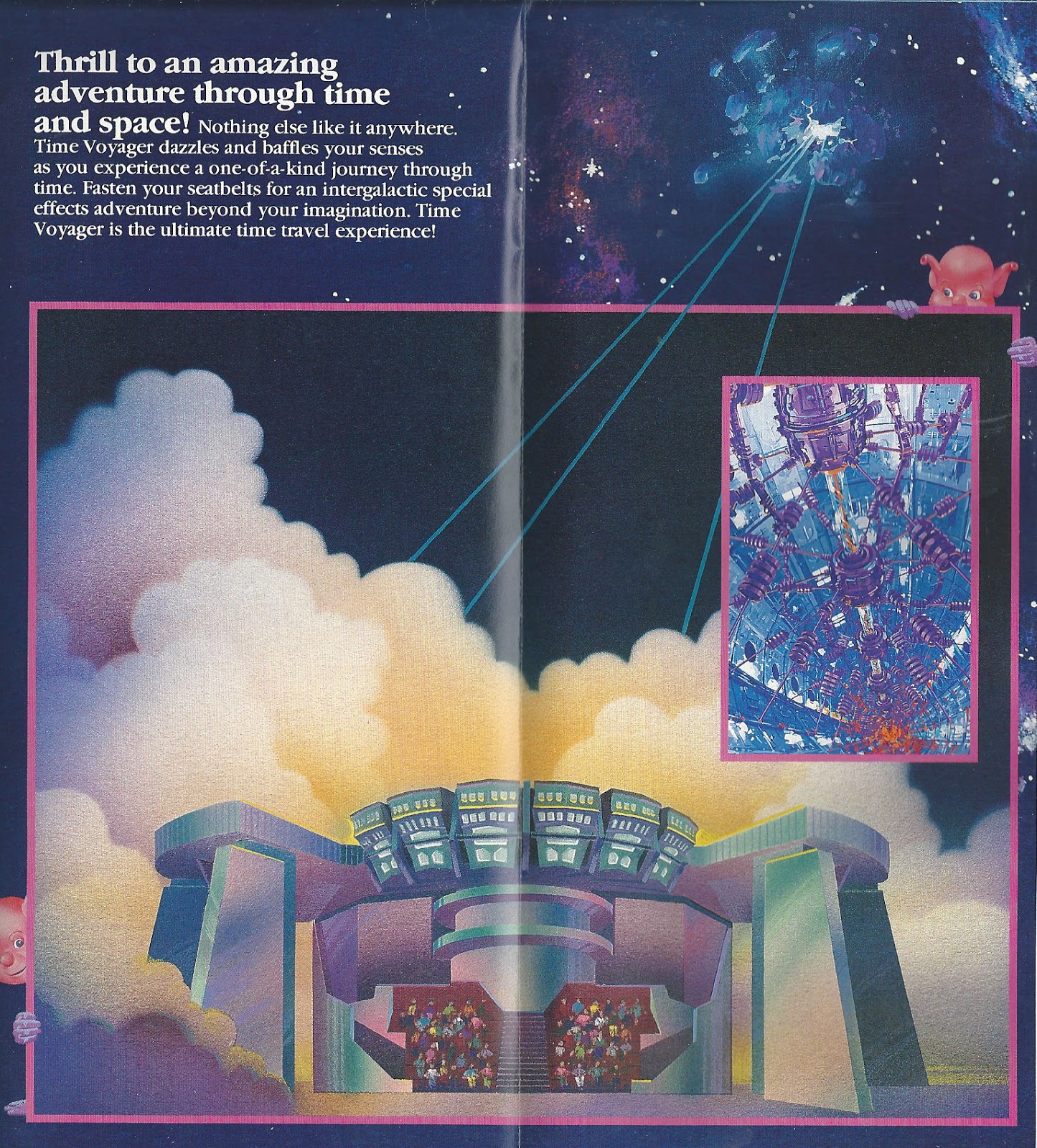
Opening Memorial Day, 1986, six months before Star Tours, Time Voyager was an "experience of astonishment and wonder" that took passengers on an "intergalactic time travel experience" that blended "special effects, advanced computer technology, three-dimensional imagery, and Dolby sound and motion in an interactive global theatre setting".


Time Voyager was commissioned by Wrather Port Properties, Ltd. as part of a campaign to reinvigorate the Queen Mary and Spruce Goose exhibits they managed in Long Beach, California. The attraction itself was designed by John F. Decuir, Jr., a special effects designer for film who had worked on Ghostbusters and Fright Night (his father, John Decuir, had done design work for Disneyland, Disney World, and EPCOT Center.)


Installed under the geodesic dome that housed Howard Hughes' H4-Hercules plane, Time Voyager consisted of a sixty-foot diameter, 100-seat carousel-style theater that rotated to face a circle-shaped movie screen (or "porthole"). Electronic tilting seats and in-theater laser effects promised an experience of flight through Earth's atmosphere and into space itself.


Additionally, riders could expect a "close encounter" with friendly aliens called Orbons, who lived in the colony of Orloxin, "known to Earthlings as Halley's Comet".

That a reference to Halley's Comet was worked into the ride narrative was a timely one in 1986, as the short-period comet was completing another 75-year circuit and was visible not only through astronomer's telescopes but in various pockets of pop-culture as well (the 1985 Claymation film The Adventure of Mark Twain depicted a fantastic attempt to visit Halley's Comet on a spaceship, while software publisher Mindscape had released an educational game, The Halley Project, for home computers.)


So we have intergalactic travel, aliens, a flight-simulator style motion theater, laser effects, "astonishment and wonder"... on paper, this sounds like it has all the elements of the anticipated Star Tours attraction. Time Voyager may very well offer a sneak preview into what to expect when Star Tours finally opened the following year, was my thinking, as I convinced my family to purchase tickets ($11.95 for adults, $7.95 for children) when we visited on our 1986 Summer vacation.


Now, I had a real hard time finding information about Time Voyager on the web, outside of promotional blurbs in archived travel magazines. No personal memories posted by riders or vintage vacation photos. No discussions about the history of the ride on fan sites, or virtual recreation videos. Even designer John Decuir Jr's on-line bios frequently omit it (the only mention I could find was at the bottom of his Attractions resume at his website, here.)


And I think I know why.

Time Voyage, it turns out, was very lame.

More disappointing than that awful Kool-Aid Man game!


First of all, the "porthole" screen was just too small. It didn't come anywhere close to filling your field of vision, so the intended immersive effect of a simulator was never achieved. It felt more like you were watching a large television screen than looking out a spaceship window.

Second, rather than the entire theater tilting to simulate the pitch and roll of flight, the theater remained stationary and only your seats moved, tilting jerkily left or right. This simply didn't work. The screen remained stationary as well, so you felt completely disconnected from the on-screen action while watching it from your uncomfortably tilted seat.

Finally, we have to talk about these Orbons. These were the friendly extra-terrestrials that we encounter as we pass Halley's Comet.

Too friendly.


The aliens looked like little bald gremlins, and appeared in person as a full-head costumed character. At some point in the ride, an Orbon would emerge from hiding and proceed to dance around and wave at the audience from the front of the theater.

The handicapped seating was also located towards the very front, putting any wheelchair-seated rider in uncomfortably close proximity to the Orbon's performance area. On my visit, the Orbon, perhaps conscious that a wheelchair rider was practically sharing the stage with him, kept hugging him, patting him on the head, and otherwise making the poor guy part of the show, whether he wanted to be or not. It was all a little cringey, even to this obnoxious teenager.

I have no idea how long Time Voyager lasted, but I did not find it mentioned in a Dec. 1988 blurb for the Queen Mary/Spruce Goose attraction, and it wouldn't surprise me if had closed sooner than that.

Later that day, while roaming around the Spruce Goose exhibit, I passed a mom and dad with a young boy of maybe six or seven, who was cheerfully singing to himself.

The words his sing-song voice was reciting were, "I hate Time Voyager." Ouch!

Anyone have memories of this short-lived, definitely-not-to-be-confused-with-Star-Tours attraction?

Tuesday, April 25, 2017

Beautiful Ruins: Sifting Through the Wreckage of Thundarr the Barbarian (1980)


When Thundarr the Barbarian finally made landfall on the shores of the 1980 Saturday morning cartoon lineup, the accompanying shockwave upturned the nation's cereal bowls.

Thundarr the Barbarian was the glorious mash-up of Robert E. Howard's Conan (hey, the word "Barbarian" is right in the title!), classic 60's Hanna-Barbara sci-fi adventure fare (Space Ghost, The Herculoids, Birdman, etc.), Star Wars (don't dare call Thundarr's "fabulous Sun-sword" a light-saber) and Planet of the Apes/Damnation Alley (or whatever scorched-Earth post-apocalypse title works for you) that I didn't realize I was waiting all my life for.

A Ruby-Spears production, Thundarr the Barbarian was the fortunate son of three Dads who could definitely beat up your Dad: writer Steve Gerber (Howard the Duck, Man-Thing), and legendary comic book/animation artists Jack Kirby and Alex Toth (a collective legacy too rich to enumerate here).

Thundarr's back-story, told in the quickly edited opening sequence, is merely the destruction of modern civilization as we know it, a global catastrophe of massive tidal waves, volcanoes, and earthquakes caused by a close call with a runaway planet in the too-far-away-to-fathom year of 1994. Fast-forward two-thousand years later, and life on Earth has become an anachronistic hodgepodge of Medieval barbarity, futuristic technology, and mutated life forms resembling mythic monsters, extra-terrestrial aliens, and everything in between.
Episodes would often start in media res, right in the middle of an action sequence whose beginning we never saw, and could feature anything from pirates to robots, wizards, werewolves, giant insects, helicopters or hover boards.

Thundarr was an unapologetic fighter, eager to slice first, ask questions later (...or never). After one particularly impressive demonstration of swordplay protecting a village from flying monsters, a gawking villager asks, "What kind of man are you?"

"Free!" Thundarr barks in reply.

Is it okay to swoon now?

His traveling companions are Ariel, a self-sufficient magic-wielding Princess (princess of what, we're never really sure) who acts as Thundarr's guide (she's learned about the ways of "old Earth" from her father's library) and Ookla the Mok, a tall, growling lion-man, clearly modeled after Chewbacca, who provides both muscle and the occasional comic relief.

But these were dramatic adventure stories, not comedies, a refreshing dose of seriousness when so many cartoons of the day relied on gags and canned laughter.

That these adventures of "savagery, super-science and sorcery" play out across the wreckage of "old Earth", often in the shadow of real-world landmarks, adds a layer of poignancy, a constant, bitter reminder that the world we know has ended in tragedy.

Below are selected images of the beautiful ruin that is old Earth.

New York ("the ruin of Man-Hat") from S1E1, Secret of the Black Pearl.
Space shuttle carcass at a ruined NASA Space Center, S1E3 Mindok the Mind Menace. This episode predates the first space shuttle launch by almost six months.
Empty streets and a crashed ocean liner from S1E4 Raiders of the Abyss.
WWII-era plane and hangar, S1E5 Treasure of the Moks.
The remnants of Mt. Rushmore, S1E6 Attack of the Amazon Women.
The Capitol Building, a fallen Washington Monument, the Lincoln Memorial, the Smithsonian Institute, the U.S. Supreme Court Building, and the White House. From S1E7 The Brotherhood of Night.
Fremont Street, downtown Las Vegas. S1E8 Challenge of the Wizards.
This is not an actual castle, but a crumbling movie set on a studio backlot in Hollywood. S1E9 Valley of the Man-Apes.
An old church covered in snow. S1E10 Stalker from the Stars.
An amusement park from the same episode.
The Alamo, San Antonio, Texas. S1E11 Portal Into Time.
Chinatown, San Francisco. S1E12 Battle of the Barbarians.
Artifacts from the old world, embedded in rock. S1E13 Den of the Sleeping Demon.
Abandoned hospital and operating theater, from the same episode
Skeleton of a swingset.
The remnants of the St. Louis Arch, Missouri, from S2E1 Wizard War.
Corpse of a Hyundai. S2E2 Fortress of Fear.
All the time in the world. Big Ben, London. S2E3 Island of the Body Snatchers.
Two freeway exits and Logan Airport, Boston. S2E4 City of Evil.
Abandoned zoo. S205 Last Train to Doomsday.
Beverly Hills, California. S2E6 Master of the Stolen Sunsword.
Eternal Pasture Cemetery, Hollywood, CA. S2E6.
Hollywood sign. S2E6.
Hollywood Magic Palace, S2E6.
Los Angeles parking garage and poolside wreck. S2E6.
Griffith Observatory, Los Angeles. S2E6.
Welcome to Atlanta, Georgia. S2E7 Trial by Terror.


...
The backgrounds weren't all doom and gloom. Sometimes the animators would slip in pop-culture references or in-jokes (in one episode you can just make out a sign for "Westwind Steak House Restaurant"... Westwind was the name of the studio that handled production layout for the show).

Here's a Jaws sequel reference (S1E1) that predates the one in Back to the Future II by almost a decade:

A reference to the forthcoming Star Wars sequel, still titled "Revenge of the Jedi" when this episode aired in November 1980, and another Jaws reference, from S1E5:

Thundarr the Barbarian can be purchased on a 4-DVD set as a Warner Archives Collection MOD release.